Since we’re off and exploring Sicily, we can’t forget to eat. Today we’ll skip right to dessert with Sicily’s Traditional cannoli. These are not the ones you’ll find in an American bakery, these are made with Ricotta filling.
Traditional Cannoli Shells
(Makes about 18)
Ingredients:
3 cups flour
1/4 cup sugar
1 teaspoon cinnamon
1/4 teaspoon salt
3 tablespoons shortening
2 eggs, well beaten
2 tablespoons white vinegar
2 tablespoons cold water
1 egg white, slightly beaten
Vegetable oil for deep frying
Directions:
Sift together flour, sugar, cinnamon, and salt. Cut shortening in with a pastry blender until the pieces are the size of small peas. Stir in eggs. Blend in the vinegar and cold water. Turn dough onto a lightly floured surface and knead until smooth and elastic, about 5 minutes. Add additional flour, if needed, to get a smooth dough. Wrap in plastic wrap and refrigerate 30 minutes.
Set out 6 aluminum cannoli tubes. Heat oil in a deep saucepan to 360 degrees F. Cut an oval shaped pattern from cardboard about 6x4-inches.
Roll chilled dough on a lightly floured surface to 1/8-inch thickness.
Place the cardboard pattern on dough and cut out as many as will fit on the dough. Wrap dough loosely around tubes slightly overlapping opposite ends.
Seal ends by brushing with egg white and pressing together. Fry only as many shells as will float uncrowded in the hot oil. Fry until light golden brown, 3-4 minutes. Remove cannoli shells to paper towels to drain. Cool slightly and remove the tubes. Cool shells completely. Continue forming and frying cannoli shells.
Using a pastry bag or a small spoon, fill the shells with the filling from both ends. Do not fill the shells until up to an hour before serving, as the filling will make the shells soggy. Sprinkle ends with reserved chopped pistachio nuts and dust with confectioner’s sugar.
Traditional Ricotta Cannoli Filling
Ingredients:
4-1/2 cups ricotta cheese
1 cup sugar
1 tablespoon vanilla
1/2 cup mini chocolate chips or candied fruit
1/2 cup pistachio nuts, coarsely chopped
Confectioners sugar for dusting
Directions:
Combine ricotta, sugar, and vanilla. Beat until smooth.
Stir in chocolate chips or candied fruit.
After filling the cannoli shells, dip the ends in chopped pistachios.
Dust the top of the cannolis with confectioners' sugar.
Alternate Ricotta Filling:
4 cups ricotta cheese and 1/2 cup cream cheese
1 cup sugar
1 tablespoon vanilla
3/4 - 1 teaspoon of cinnamon
1/2 cup chopped chocolate or candied fruit, if desired
Let Rawhide Travel and Tours help you get there and if you want to stay in comfort rather than camping out we can help. Call us at (602) 843-5100 or visit our website: rawhidetravel.com
Presented By:
Rawhide Travel and Tours Inc.
6008 West Bell Road # F105
Glendale, Arizona 85308-3793
602-843-5100
rawhidetravel.com
Sicily is the largest island in the Mediterranean Sea, it is located in the central Mediterranean and extends from the tip of the Apennine peninsula towards the North African coast. Sicily has more sandy beaches and dramatic coastline than any other region of Italy, and it's warm enough for swimming 6 months of the year (May-Oct). On almost any average spring day, temperatures in Sicily are 64 - 72 °F with water temperatures in the 50s and 60s, perfect for a day at the beach. Fantastic shorefront restaurants abound, and there are plenty of ways to get out on the water. The following beaches are just a sample of what Sicily has to offer.
Mondello
A crescent bay with shallow water,white sand and a carnivalesque atmosphere make this the perfect beach for families. Windsurfing and snorkeling are popular here, and the grand Stabilimento Balneare (bathing club), built in 1913, is an excellent example of the old-fashioned European good life. Mondello is an easy 15-minute bus ride from Palermo, so it's best to visit as a day trip from there.
Mazzarò
At the bottom of the cableway is a small bay with several beach clubs and kayak rentals. The larger bay to the south is punctuated in the middle by Isola Bella, a gorgeous island and World Wildlife Federation nature reserve that's connected to the beach by a narrow spit of sand that you can walk or wade to the island, depending on water level. If you are interested in seeing where young Italians party, take a bus to Giardini-Naxos, a modern resort development with budget hotels and thumping nightclubs on the beach.
San Vito lo Capo
A glittering sandy beach, irresistible turquoise water, and a dramatic mountain at land's end (Monte Monaco) make this spot between Trapani and Palermo one of Sicily's best up-and-coming resort destinations. At first glance it might remind you of a postcard from Rio de Janeiro -- a broad expanse of white sand lines a curving bay, with a massive mountain promontory at one end. However there are no high-rises or wild nightlife here. This is a popular summer destination for Italian families and couples. Swimming in the turquoise waters here, with the imposing contours of Monte Monaco to the east, is an unforgettable experience. You can catch organized boat tours of the nearby Zingaro and Scopello nature reserves and it is a great way to access hidden coves and see unspoiled Sicilian flora and marine wild life.
Selinunte
On the south west coast of Sicily, not far from Mazara del Vallo, lies one of the largest and most impressive archaeological sites in the Mediterranean. Selinunte has lain abandoned for over 2,000 years and has numerous temples, acropolis and agora in dignified ruins. It is on par with pretty much anything found in Greece itself. Selinunte is beautifully located, sitting on a high plain and overlooking the sea. It is flanked on either side by golden beaches, not quite a mile wide, is an excellent excuse for a good walk, though it is also possible to get around on electric buggies.
Slide at Città del Mare
Not a beach but possibly worth a look, Located on the northwest coast of Sicily, on the Gulf of Castellammare, the hotel Città del Mare boasts one of the coolest waterslides. Carved into the side of the cliffs and heading straight into the Mediterranean, this water slide could add an exciting touch to a memorable trip.
Let Rawhide Travel and Tours help you get there and if you want to stay in comfort rather than camping out we can help. Call us at (602) 843-5100 or visit our website: rawhidetravel.com
Presented By:
Rawhide Travel and Tours Inc.
6008 West Bell Road # F105
Glendale, Arizona 85308-3793
602-843-5100
rawhidetravel.com
Rawhide Travel and Tours with combined total of more than “75 years of travel experience" provides amazing deals for your dream vacation with experienced, friendly travel experts.
 Services offered include booking domestic and international air travel, hotel and resort reservations, car rental and cruises for individuals, corporate, group and incentive travel. Also tour packages of every type from a weekend getaway, to San Diego or Disneyland to involved and detailed vacations worldwide.
Plan your next great vacation with Rawhide Travel and Tours. Call today (602) 843-5100 or email us at flythis@rawhidetravel.com.
Presented By:
Rawhide Travel and Tours Inc
6008 West Bell Rd # F105
Glendale, Arizona 85308-3793
(602) 843-5100
rawhidetravel.com
With many cruise liners in the news, travelers are eager for a glimpse of the Viking Star -- the much-awaited first ocean ship from river cruise giant Viking. Viking is a fast growing company and the move into ocean cruising comes as the company increasingly dominates the world of river cruising. The line last month christened 12 new river ships, on top of 18 vessels added in 2014. The company now has 64 river ships in all.
The Viking Star is the prototype for at least two but more likely many more new ocean vessels. Scheduled to be christened in May in Bergen, Norway, Viking Star is being hailed by some as the most significant new cruise ship of the year. Compared to the mega ships of Royal Caribbean and Norwegian Cruise Line, the Viking Star is a third the size, but is designed to mix onboard elegance with a focus on destinations that Viking executives say has been lost across much of the cruise industry in recent years.
Supposedly the Viking Star's itineraries will feature more time in ports than at many other lines, and it is being said that shore excursions will be included in the price, not common among the other lines. Don’t frown at the ship’s smaller size, the Viking Star will be able to access smaller ports that often are off limits to today's megaships.
The Viking Star, a 930 passenger vessel, has a modern Scandinavian design that echoes what is found on Viking's river ships. Cabins are large for a cruise ship, with the smallest of five cabin categories having 270 square feet of space. In addition, every cabin has a balcony. Fourteen two-room suites on the ship range from 757 to 1,448 square feet and offer sweeping views from wrap-around private balconies.
Viking encourages you to expand your horizons on comfortable, state-of-the-art ships, intimate and thoughtfully created by experienced nautical architects and designers to enrich your interaction with your destination in every way. Everything is set in tasteful elegance and designed to deliver a life-enriching experience that stays with you forever.
What can you expect on these cruises?
There is the Wintergarden, perfect for a calming cup of tea; a Library, packed with books to add to your knowledge or try the Spa, a Nordic sanctuary of wellness.
Also onboard you can attend inspiring talks that help you understand every destination in depth. The company believes the best way to understand a country is through enrichment. Each cruise is thoughtfully curated with hand-picked itineraries so you can immerse yourself in history, music, art, cuisine, everything you need to know about your destination.
The ships offer multiple restaurant venues and unique dining experiences, from cafes and pool grills to wine-pairing menus and regional specialties. Savor the rustic Tuscan cuisine of Manfredi's Italian Restaurant and sample a delicious array of global and destination-based cuisine at the World Café.
As with all cruise liners you can’t forget about the pool. You can swim surrounded by your destination in the glass-backed Infinity Pool cantilevered off the stern or experience the Main Pool, complete with a retractable roof. The main pool is where you can enjoy an outdoor movie as you sail under a canopy of stars.
Let Rawhide Travel and Tours help you get there and if you want to stay in comfort rather than camping out we can help. Call us at (602) 843-5100 or visit our website: rawhidetravel.com
Presented By:
Rawhide Travel and Tours Inc.
6008 West Bell Road # F105
Glendale, Arizona 85308-3793
602-843-5100
rawhidetravel.com
If sand, sun and sea have you beat The Cornwall area has some unique and varied habitats to explore. Just a 24 minute drive and you will enter the Goss Moor National Nature Reserve or for a longer drive (approx. 44 min) You can view the ancient forests surrounding Golitha Falls.
Goss Moor
A National Nature Reserve in Cornwall, England, located 7.5 mi south-west of Bodmin. It is overlooked by Castle an Dinas to the north, and the church of St Dennis in the south. It is the largest continuous mire complex in south-west Britain and consists of mainly peatland and lowland heath. This reserve is situated in a broad relatively flat, valley basin which forms the headwaters of the River Fal. It contains areas of dry and wet heath, mire, fen and open water, and a diverse mix of wildlife habitats. These are home to some of the country’s rarest species. The River Fal rises on the moor at Pentivale and flows (11 mi) to the English Channel at Carrick Roads. Together with the neighboring moor to the east, it forms the Goss And Tregoss Moors Site of Special Scientific Interest (SSSI), as well as the Breney Common and Goss and Tregoss Moors Special Area of Conservation (SAC).
History
Between 1908 and 1916 steam powered suction and cutter dredges were used for the mining of alluvial tin on the moor. Drilling took place in 1908 and 1909 but the position of the boreholes and what they contained have been lost. Approximately 70 tons of tin concentrate was extracted and the dredges were later moved to Breney Common, Molinnis and Red Moor. The area was designated as the Goss and Tregoss Moors Site of Special Scientific Interest in 1988.
Features of Interest
The reserve’s range of habitats and species has resulted in its being designated a Site of Special Scientific Interest and a Special Area of Conservation. It is home to a number of scarce and rare species including:
Plants
Some of Cornwall’s rarest vascular plants can be found on the site, such as the nationally scarce yellow centaury (Cicendia filiformis), marsh clubmoss, cornish moneywort and pillwort.
Invertebrates
18 species of dragonflies and damselflies present, including the nationally scarce small red damselfly and the variable damselfly.
Butterflies and Moths
29 species of butterfly have been recorded at the reserve, including the marsh fritillary, Silver-studded Blue, Small Pearl-bordered Fritillary, Grizzled Skipper. Moths include the narrow-bordered bee hawk and double line.
Mammals
Dormice reside both in the grassy open areas and in the areas dominated by willow. Otters are nocturnal visitors, as are roe deer, which can be seen at dawn and dusk as they venture out to graze.
The River Fal and associated wetlands support populations of eel and brook lamprey. Over 70 species of birds breed on the site, with others arriving on the reserve to spend winter. These include bittern, great grey shrike and hen harrier.
Golitha Falls
Golitha Falls NNR is a steeply sided wooded valley, with the River Fowey flowing through it in a series of spectacular cascades that drop 295 feet in altitude. Much of the reserve is a long gorge, lined with ancient oak woodland, with Draynes Wood recorded in the Domesday Book (1086),that gives way to the River Fowey at the bottom.
Like Goss Moor, this site is designated a Site of Special Scientific Interest for its woodland flora. The dramatic landscape created by the River Fowey is designated an Area of Outstanding Natural Beauty. It’s one of Cornwall’s richest valleys for bryophytes in Cornwall, with more than 120 species recorded here. It is equally important for lichens, with 48 species including the nationally rare Parmelia minarum. Woodland wildflowers include bluebells and wood anemone. In spring the woodland floor is carpeted with bluebells and wood anemones, while the meadow areas see bugle, self-heal, white clover, common tormentil and valerian species flourish.
The reserve is also home to dormice, which reside in the ancient hazel coppice. Noctule, brown long-eared and lesser horseshoe bats have also been recorded.
The river supports healthy populations of both salmon and sea trout. Otters are often seen exploring the falls.
The reserve supports 83 species of moth, including the notable double lines. Butterflies include the meadow brown, marbled white, green veined white, gatekeeper, small skipper, ringlet, speckled wood and silver-washed fritillary.
Extra care should be taken when visiting after heavy rainfall as the waterfalls can become torrential.
Let Rawhide
Travel and Tours help you get there and if you want to stay in comfort
rather than camping out we can help. Call us at (602) 843-5100 or visit
our website: rawhidetravel.com
Presented By:
Rawhide Travel and Tours Inc.
6008 West Bell Road # F105
Glendale, Arizona 85308-3793
602-843-5100
rawhidetravel.com
The recipe for a Cornish pasty, as defined by its protected status, includes diced or minced beef, onion, potato and swedes (rutabaga) in rough chunks along with some "light peppery" seasoning. The cut of beef used is generally skirt steak. Swedes is sometimes called turnip in Cornwall but the recipe requires use of actual swedes, not turnip. Pasty ingredients are usually seasoned with salt and pepper, depending on individual taste. The use of carrot in a traditional Cornish pasty is frowned upon, though it does appear regularly in recipes.
The type of pastry used is not defined, as long as it is golden in color and will not crack during the cooking or cooling, although modern pasties almost always use a shortcrust pastry. There is a humorous belief that the pastry on a good pasty should be strong enough to withstand a drop down a mine shaft, and indeed the barley flour that was usually used does make hard dense pastry.
Variations
Although the official pasty has a specific ingredients list, the earliest recorded pasty recipes include venison, not beef. "Pasty" has always been a generic name for the shape and can contain a variety of fillings, including stilton, vegetarian and even chicken tikka. Pork and apple pasties are readily available in shops throughout Cornwall and Devon, with the ingredients including an apple flavored sauce, mixed together throughout the pasty, as well as sweet pasties with ingredients such as apple and fig or chocolate and banana, which are common in some areas of Cornwall.
Cornish Pasty Recipe
This recipe is for six good sized Cornish pasties.
Ingredients
For shortcrust pastry:
3 ¾ cups strong bread flour (it is important to use a stronger flour than normal as you need the extra strength in the gluten to produce strong pliable pastry)
½ cup lard or white shortening
9 tablespoon Cornish butter
1 teaspoon salt
¾ cup cold water
For the filling:
1 pound good quality beef skirt, cut into cubes
1 pound diced potato
6 ounces diced swedes (substitute a rutabaga)
½ pound sliced onion
Salt & pepper to taste (2:1 ratio)
Beaten egg or milk for glaze
Directions
1. Rub the two types of fat lightly into flour until it resembles breadcrumbs.
2. Add water, bring the mixture together and knead until the pastry becomes elastic. This will take longer than normal pastry but it gives the pastry the strength that is needed to hold the filling and retain a good shape. This can also be done in a food mixer.
3. Cover with cling film and leave to rest for 3 hours in the fridge. This is a very important stage as it is almost impossible to roll and shape the pastry when fresh.
4. Roll out the pastry and cut into circles approx. 8 in diameter. A side plate is an ideal size to use as a guide.
5. Layer the vegetables and meat on top of the pastry, adding plenty of seasoning.
6. Bring the pastry around and crimp the edges together (see crimping).
7. Glaze with beaten egg or an egg and milk mixture.
8. Bake at 450 degrees F for 10 minutes. Turn oven down to 350 degrees F, and bake for 35 minutes or until golden.
Top Tips:
Beef skirt is the cut traditionally used for Cornish pasties. This is the underside of the belly of the animal. It has no gristle and little fat, cooks in the same amount of time as the raw vegetables and its juice produces wonderful gravy. Use a firm waxy potato such as Maris Peer or Wilja. A floury potato will disintegrate on cooking.
How to crimp
Crimping is one of the secrets to a true Cornish pasty. A good hand crimp is usually a sign of a good handmade pasty. To crimp a Cornish pasty;
1. Lightly brush the edge of the pastry with water.
2. Fold the other half of pastry over the filling and squeeze the half circle edges firmly together.
3. Push down on the edge of the pasty and using your index finger and thumb twist the edge of the pastry over to form a crimp.
4. Repeat this process along the edge of the pasty.
5. When you have crimped along the edge, tuck the end corners underneath.
Let Rawhide Travel and Tours help you get there and if you want to stay in comfort rather than camping out we can help. Call us at (602) 843-5100 or visit our website: rawhidetravel.com
Presented By:
Rawhide Travel and Tours Inc.
6008 West Bell Road # F105
Glendale, Arizona 85308-3793
602-843-5100
rawhidetravel.com
Newquay is a town, seaside resort and fishing port in Cornwall, England. It is situated on the North Atlantic coast of Cornwall approximately 20 miles west of Bodmin and 12 miles north of Truro. A lovely get away that is famous for the sandy beaches, blue sea and captivating coastlines. The beaches are truly the beating heart of Newquay. Wherever you are in Newquay, you are guaranteed not to be far from one of these stunning beaches, each of them offering a different beach experience, anything from family visits, surfing, boating, horseback riding and fishing.
Great Western
A popular family beach, just north of Towan beach, it is comprised of several coves offering some degree of seclusion. The beach is backed by high cliffs so the best time to visit this beach is at low tide when it joins with Towan and Lusty Glaze to create a vast expanse of golden sand. The beach is exposed to moderate Atlantic swells which can create surf – this beach is also ideal for novice surfers. Great Western Beach is 2 minutes walking from the town centre where there is also parking. Facilities include a café, public toilets and deckchairs. There are lifeguards from 21st May – 25th September.
Lusty Glaze Beach
A popular sandy horseshoe shaped cove, surrounded by high cliffs with direct access to the sea on the outskirts of Newquay. This is a great family beach with fun activities for all ages and abilities and superb beach-side facilities. This beach ‘village’ is a first-class attraction with a lot going on. As well as the beautiful sandy cove to explore, there's a beach-side restaurant, a range of activities and the opportunity to experience fantastic live music and events both during the day and evening. The beach is surrounded on 3 sides by cliffs 150ft high creating the perfect setting for the only beach zip wire in Cornwall. At 750ft long and 120ft high, this aerial runway is one of Europe’s longest, highest and fastest. Lusty Glaze Beach is developing a reputation as a live music venue. The natural amphitheatre of this horseshoe shaped cove surrounded by high cliffs makes a truly remarkable concert venue. There is parking adjacent to the beach and toilets and showers and beach huts are available to hire.
Towan Beach
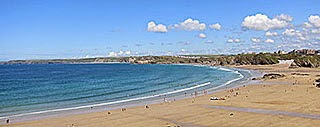
The most central of Newquay's beaches, It is sheltered by Towan Head and provides either small waves, ideal for novice surfers or calm waters for safe swimming. At high tide the beach gets covered and people retreat to the Promenade with its shops and cafes or to the grassy slopes on the clifftops. Towan is a popular and often very busy beach, right in the centre of town. Good size of sand and rock, popular with both surfers and families. The Blue Reef Aquarium right by the beach is a fascinating attraction for young and old. Use Town Centre parking which is a few minutes away from the beach, there are facilities including a café and public toilets. Lifeguard coverage runs from mid May to the end of September.
Tolcarne Beach
Nestled in a beautiful crescent shaped bay set against a background of cliffs with caves to explore, this beach offers soft sand, easy swimming, surfing, exciting rock pools to investigate at low tide, sea fishing and the unique 'Tolcarne wedge' for boogie boarding. It is an ideal beach if you are looking for organised activities and plenty of amenities. Tolcarne offers lock up huts and beach tents with sunbathing platforms, surfboard rentals and a cafe. The surf school on the beach offers individual and group surf lessons for novice or intermediate surfer, is open all year with qualified BSA instructors with top quality equipment and suits. The beach is a short walk from the Town Centre. Lifeguard coverage is from mid May to September.
Let Rawhide Travel and Tours help you get there and if you want to stay in comfort rather than camping out we can help. Call us at (602) 843-5100 or visit our website: rawhidetravel.com.
Presented By:
Rawhide Travel and Tours Inc.
6008 West Bell Road # F105
Glendale, Arizona 85308-3793
602-843-5100
rawhidetravel.com


